
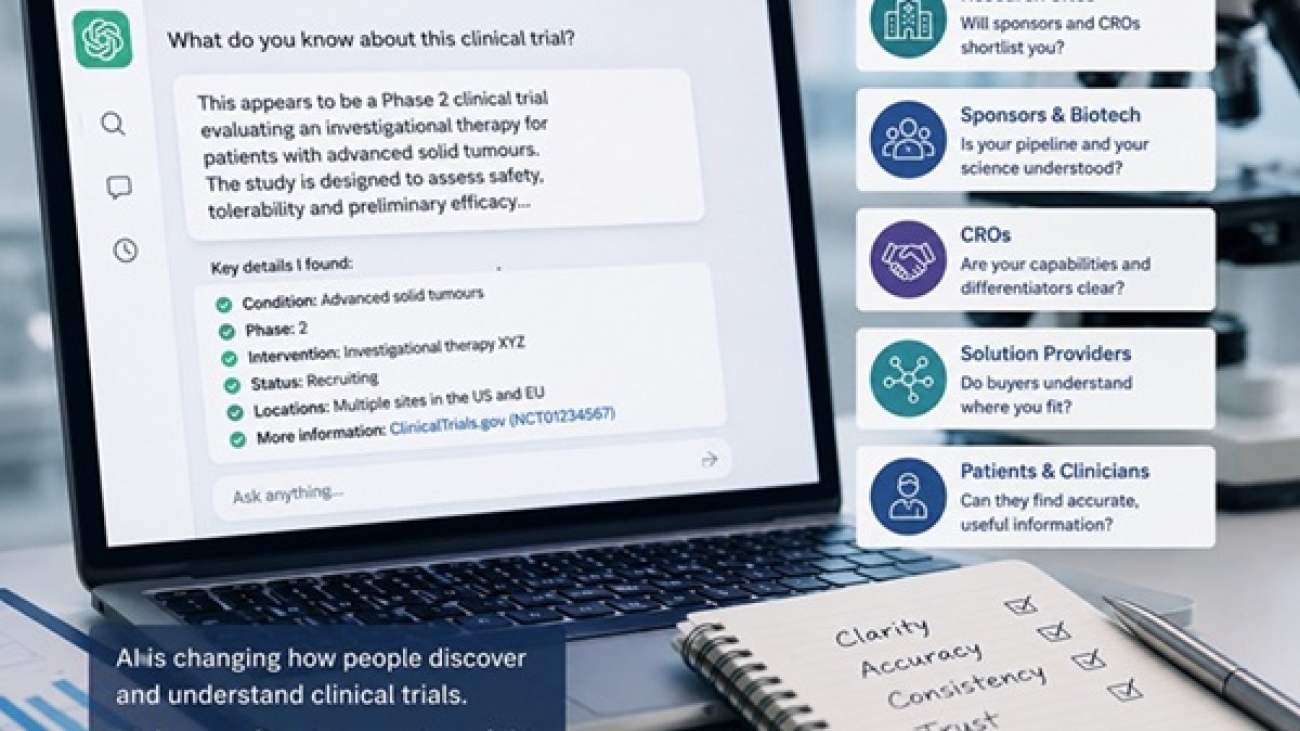
For years, clinical research organisations have worried about what appears when someone searches Google.
A different question is now becoming increasingly important:
What happens when they ask ChatGPT instead? (Or, indeed, any other AI-powered chat service)
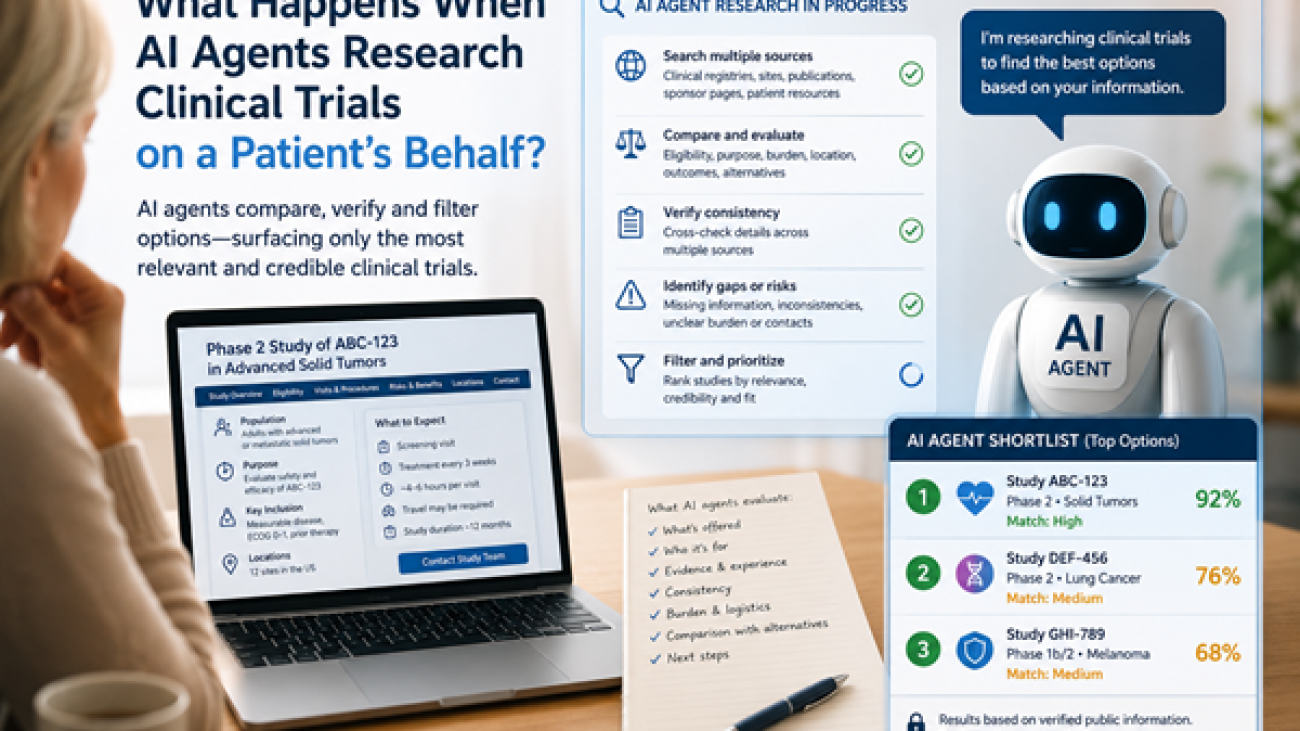
Sponsors can use AI tools to investigate research sites. Patients can use them to understand clinical trials. Clinicians can ask them about potential options. CROs can research partners. Business development teams can investigate competing providers.
And instead of returning ten blue links, the AI assistant attempts to provide an answer.
That changes the problem.
The issue is no longer simply whether your organisation or study can be found.
It is whether the AI system understands it correctly.
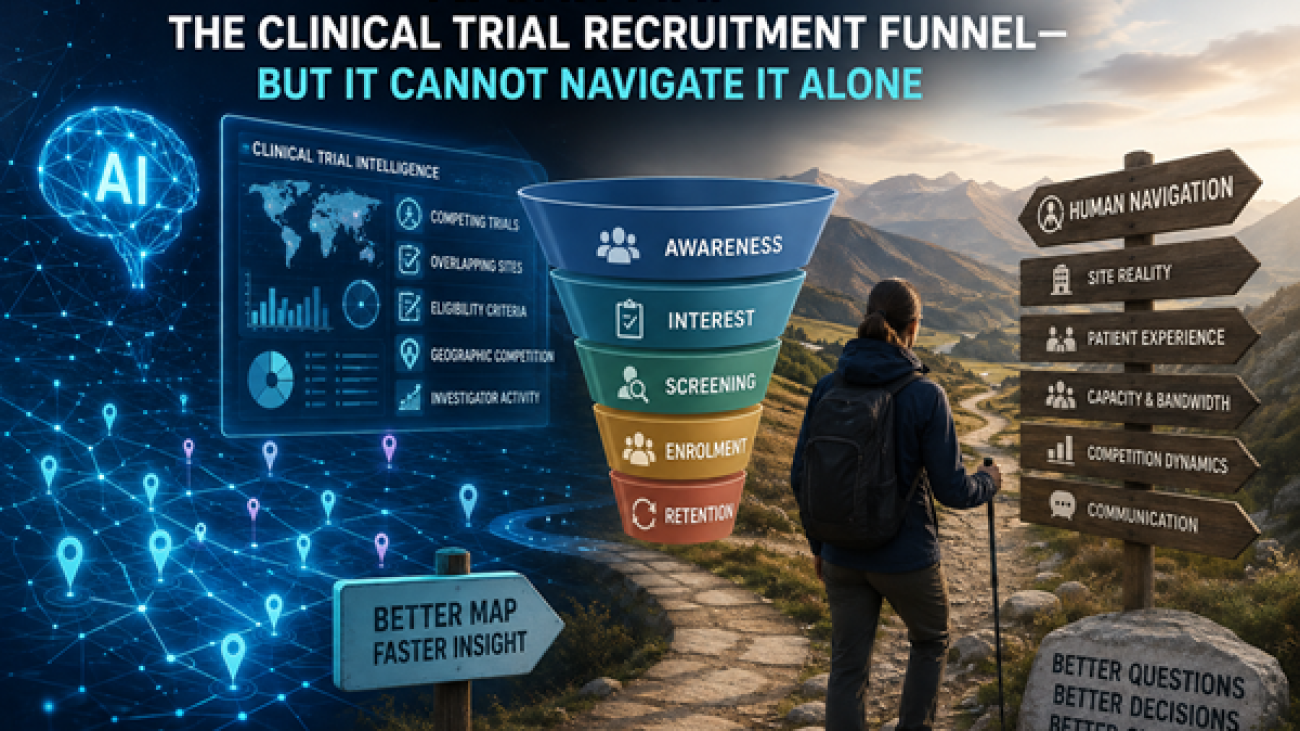
Being visible is not the same as being understood
A clinical trial may appear prominently in an AI response while still being poorly represented.
The answer might:
- omit important eligibility or participation information
- rely on an outdated source
- fail to explain why a programme is different;
- overlook important site capabilities
- combine information from sources that are not fully aligned
- provide an accurate but superficial description that gives the reader little reason to investigate further
That distinction has become increasingly apparent through the AI Visibility assessments I have been conducting across clinical research organisations and studies.
Three examples illustrate the problem.
1. A research site can be credible without being shortlist-ready
Research sites traditionally present themselves through websites, capability decks, feasibility responses and direct sponsor/CRO relationships.
But imagine a sponsor-side business development or feasibility professional asking an AI assistant:
Which research sites would be suitable for this study?
Or:
What do you know about this site and its experience in this indication?
The AI system has to construct its answer from whatever public information it can find.
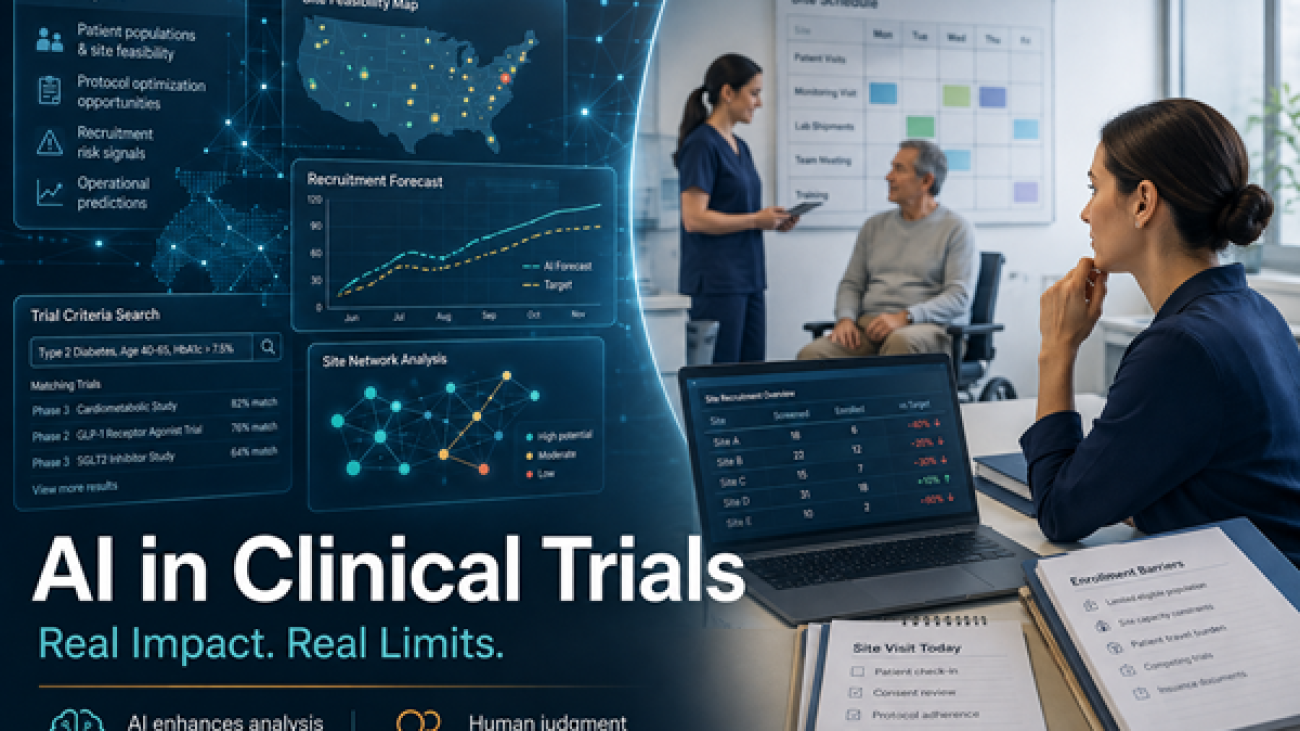
In one AI Visibility project for a US research site, one of the questions I explored was whether the site’s public presence gave AI systems enough information to understand its strengths from a sponsor or CRO perspective.
This goes beyond whether the site has a good-looking website.
An AI-assisted site assessment may depend on whether publicly available information clearly communicates things such as:
- therapeutic area experience
- investigator expertise
- patient access
- geographical coverage
- operational capabilities
- recruitment experience
- reasons the site might be particularly suitable for a sponsor’s study
A human business development professional may be able to explain those strengths perfectly on a call.
But if they are not clearly reflected in the organisation’s public information, an AI system may never make the same connection.
That creates a new question for research sites:
If AI becomes part of sponsor and CRO site prospecting, does your public presence make you look shortlist-ready?
2. AI can find the science but miss the distinction
A different problem appears when AI tools compare competing programmes.
In earlier work examining AI Visibility for two separate biopharma companies, the systems were often capable of identifying companies, programmes and mechanisms.
But identifying the programmes is not the same as explaining the differences that might matter to a patient, clinician, investigator or potential partner.
AI-generated comparisons can flatten nuance.
They may correctly describe two scientific approaches while failing to communicate why those differences matter in practice.
This is particularly important when information is spread across:
- pipeline pages
- scientific presentations
- trial registries
- investor materials
- press releases
- conference abstracts
An AI assistant is effectively being asked to synthesise that material.
If the public sources do not communicate the distinction clearly and consistently, the resulting AI answer may not either.
3. Emerging companies can be defined by whatever information AI happens to find
The problem can be more pronounced for an emerging biotechnology company.
In an assessment involving another small biotech, the challenge was not necessarily that information was wrong.
It was that there was relatively little public information available from which an AI system could construct a complete picture.
In those circumstances, AI assistants may lean heavily on sources such as:
- ClinicalTrials.gov
- press releases
- funding announcements
- investor coverage
- conference information
- third-party databases
Those sources may all be individually legitimate.
But together they may not tell the story the company itself would choose to tell.
This is why AI visibility is not simply another version of traditional SEO.
The problem is not:
How do we make the AI rank us first?
The more useful question is:
Have we given AI systems enough clear, authoritative and consistent information to understand us properly?
ClinicalTrials.gov creates a particular challenge
Trial registries are especially important because they are authoritative sources.
But registry information and live company website information do not always evolve at exactly the same pace.
A sponsor may update one source before another. Terminology may differ. Study status information may temporarily diverge. Patient-facing explanations may use very different language from formal registry entries.
An AI assistant can encounter all of those sources at once.
That does not mean organisations should avoid linking to ClinicalTrials.gov.
Quite the opposite.
Authoritative external sources are valuable.
But the information ecosystem surrounding a study needs to be coherent enough that an AI system can reconcile what it finds.
This is not about gaming AI
There is already a growing industry around AEO, GEO and techniques intended to improve visibility within generative AI systems.
Some of that work is useful.
But clinical research organisations should be wary of treating this as the next algorithm to manipulate.
Search history provides a useful warning.
Whenever a new discovery system becomes commercially important, people look for shortcuts. Early SEO produced link farms, doorway pages and countless other attempts to exploit ranking systems.
Many worked temporarily.
Most eventually disappeared as the systems became better at recognising manipulation.
AI search is likely to evolve considerably faster.
The more durable approach is much less glamorous:
- make important information clear
- keep it current
- remove contradictions;
- use authoritative sources
- explain important distinctions
- structure information so that both humans and machines can understand it
- make the next step obvious
Those are good practices regardless of which AI platform happens to dominate.
What should a research site or ClinOps team test?
A useful starting point is to stop asking:
Does ChatGPT know who we are?
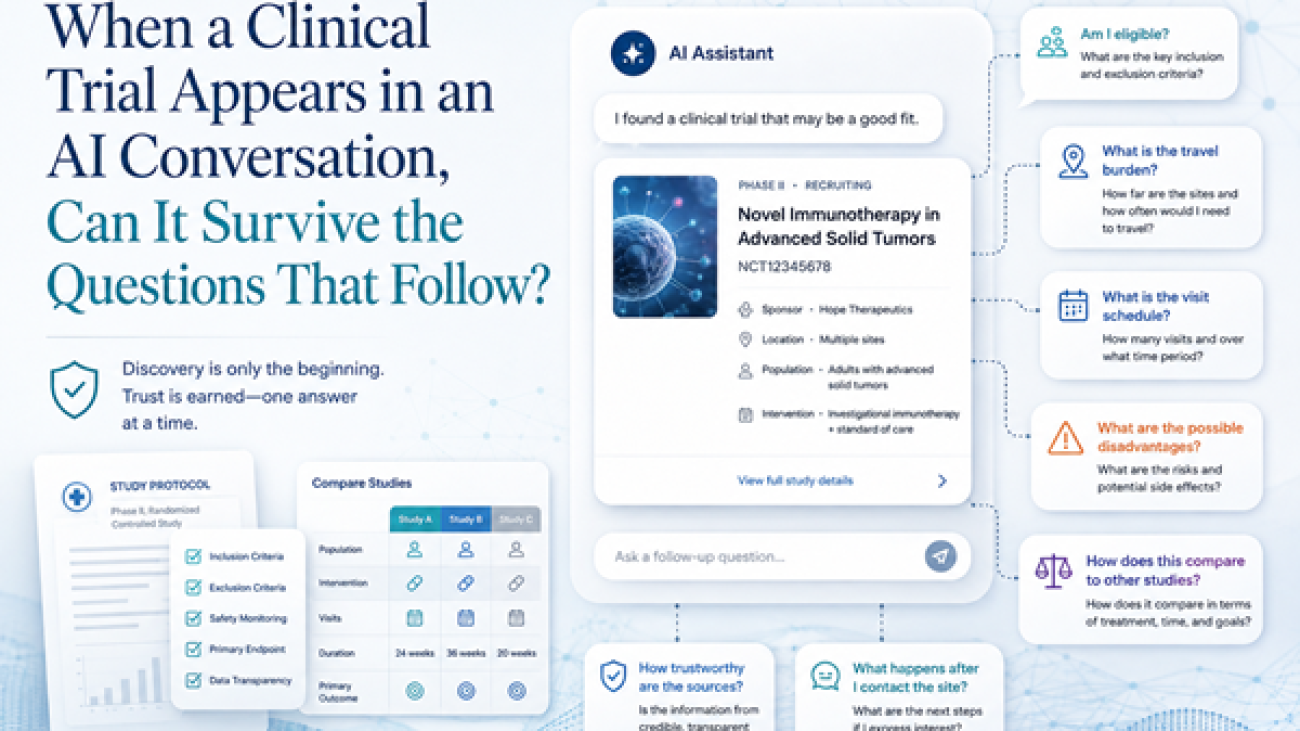
Instead, ask realistic questions that someone outside the organisation might use.
For a research site:
- What is this site’s therapeutic experience?
- Why might a sponsor choose it?
- What evidence is there of recruitment capability?
- Which studies or indications does it specialise in?
- How does it compare with other sites in the same area?
For a sponsor:
- What trials is this company currently conducting?
- How does this programme differ from competing approaches?
- What would a patient need to know about participation?
- Where would a clinician find more information?
For a CRO or service provider:
- What does this organisation actually specialise in?
- Why would a sponsor choose it rather than a competitor?
- What evidence supports those claims?
Then compare what the AI systems say with what you believe they should say.
The gaps are often revealing.
From AI visibility to AI clarity
I increasingly think AI visibility is only part of the issue.
Being mentioned is useful.
Being understood is better.
And being understood in a way that helps the reader make an informed next decision is better still.
That is why my Clinical Trials AI Visibility assessments now look beyond whether an organisation appears in an AI answer.
They examine:
- what is said
- what is missed
- whether the information is accurate;
- which sources appear to shape the answer
- whether different systems reach similar conclusions
- what a patient, sponsor, CRO, investigator or prospective partner might infer
- what changes could improve the public information available
The objective is not to manufacture favourable AI answers.
It is to make sure the organisation has provided the clearest possible raw material from which those answers are generated.
Find out what AI says about your organisation or study
I now provide Clinical Trials AI Visibility Assessments for research sites, sponsors, CROs and clinical trial solution providers.
The assessments use realistic stakeholder questions across leading AI systems to identify gaps in discoverability, accuracy, clarity, consistency, credibility and differentiation.
Find out more about Clinical Trials AI Visibility
If you work with an organisation that might benefit from understanding how it appears through AI-assisted research, I am also happy to discuss whether the approach would be relevant.