
AI-Visibility-smaller

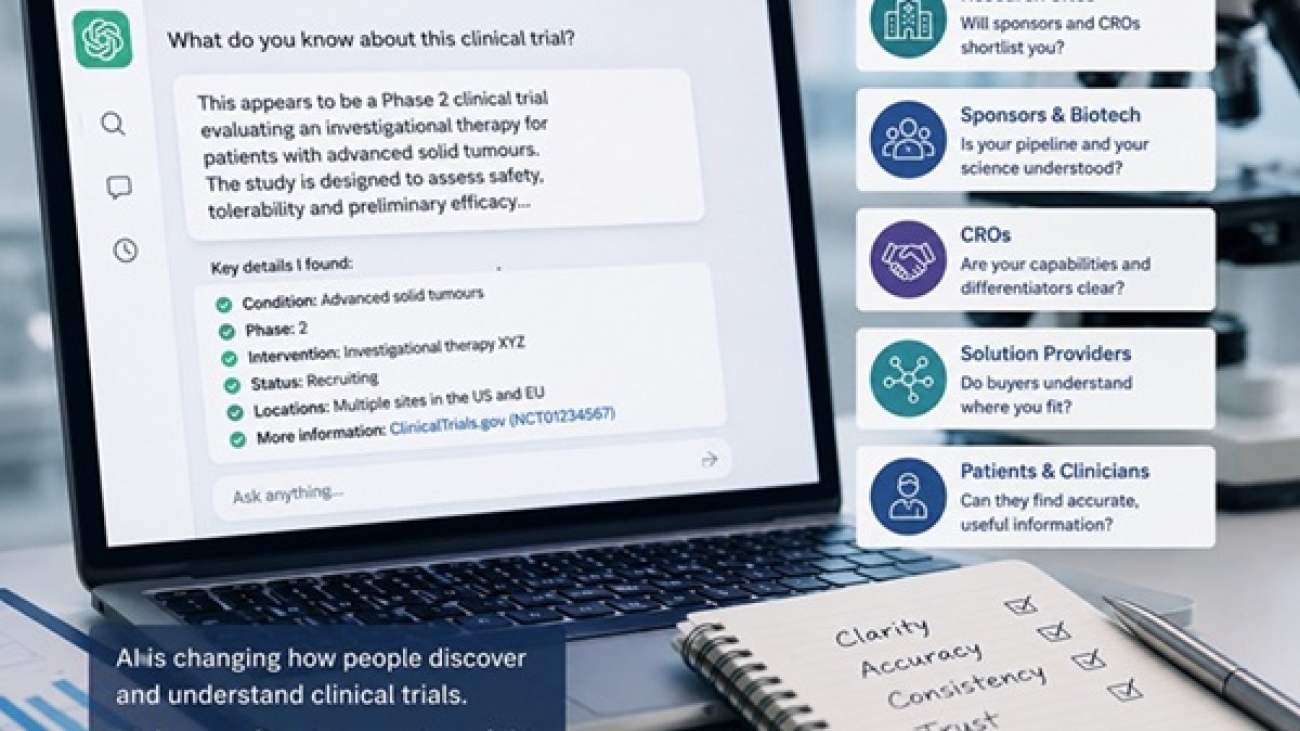
What Does ChatGPT Say About Your Clinical Trial – and Should You Care?

For years, clinical research organisations have worried about what appears when someone searches Google.

A different question is now becoming increasingly important:

What happens when they ask ChatGPT instead? (Or, indeed, any other AI-powered chat service)

Sponsors can use AI tools to investigate research sites. Patients can use them to understand clinical trials. Clinicians can ask them about potential options. CROs can research partners. Business development teams can investigate competing providers.

And instead of returning ten blue links, the AI assistant attempts to provide an answer.

That changes the problem.

The issue is no longer simply whether your organisation or study can be found.

It is whether the AI system understands it correctly.

Being visible is not the same as being understood

A clinical trial may appear prominently in an AI response while still being poorly represented.

The answer might:

  • omit important eligibility or participation information
  • rely on an outdated source
  • fail to explain why a programme is different;
  • overlook important site capabilities
  • combine information from sources that are not fully aligned
  • provide an accurate but superficial description that gives the reader little reason to investigate further

That distinction has become increasingly apparent through the AI Visibility assessments I have been conducting across clinical research organisations and studies.

Three examples illustrate the problem.

1. A research site can be credible without being shortlist-ready

Research sites traditionally present themselves through websites, capability decks, feasibility responses and direct sponsor/CRO relationships.

But imagine a sponsor-side business development or feasibility professional asking an AI assistant:

Which research sites would be suitable for this study?

Or:

What do you know about this site and its experience in this indication?

The AI system has to construct its answer from whatever public information it can find.

In one AI Visibility project for a US research site, one of the questions I explored was whether the site’s public presence gave AI systems enough information to understand its strengths from a sponsor or CRO perspective.

This goes beyond whether the site has a good-looking website.

An AI-assisted site assessment may depend on whether publicly available information clearly communicates things such as:

  • therapeutic area experience
  • investigator expertise
  • patient access
  • geographical coverage
  • operational capabilities
  • recruitment experience
  • reasons the site might be particularly suitable for a sponsor’s study

A human business development professional may be able to explain those strengths perfectly on a call.

But if they are not clearly reflected in the organisation’s public information, an AI system may never make the same connection.

That creates a new question for research sites:

If AI becomes part of sponsor and CRO site prospecting, does your public presence make you look shortlist-ready?

2. AI can find the science but miss the distinction

A different problem appears when AI tools compare competing programmes.

In earlier work examining AI Visibility for two separate biopharma companies, the systems were often capable of identifying companies, programmes and mechanisms.

But identifying the programmes is not the same as explaining the differences that might matter to a patient, clinician, investigator or potential partner.

AI-generated comparisons can flatten nuance.

They may correctly describe two scientific approaches while failing to communicate why those differences matter in practice.

This is particularly important when information is spread across:

  • pipeline pages
  • scientific presentations
  • trial registries
  • investor materials
  • press releases
  • conference abstracts

An AI assistant is effectively being asked to synthesise that material.

If the public sources do not communicate the distinction clearly and consistently, the resulting AI answer may not either.

3. Emerging companies can be defined by whatever information AI happens to find

The problem can be more pronounced for an emerging biotechnology company.

In an assessment involving another small biotech, the challenge was not necessarily that information was wrong.

It was that there was relatively little public information available from which an AI system could construct a complete picture.

In those circumstances, AI assistants may lean heavily on sources such as:

  • ClinicalTrials.gov
  • press releases
  • funding announcements
  • investor coverage
  • conference information
  • third-party databases

Those sources may all be individually legitimate.

But together they may not tell the story the company itself would choose to tell.

This is why AI visibility is not simply another version of traditional SEO.

The problem is not:

How do we make the AI rank us first?

The more useful question is:

Have we given AI systems enough clear, authoritative and consistent information to understand us properly?

ClinicalTrials.gov creates a particular challenge

Trial registries are especially important because they are authoritative sources.

But registry information and live company website information do not always evolve at exactly the same pace.

A sponsor may update one source before another. Terminology may differ. Study status information may temporarily diverge. Patient-facing explanations may use very different language from formal registry entries.

An AI assistant can encounter all of those sources at once.

That does not mean organisations should avoid linking to ClinicalTrials.gov.

Quite the opposite.

Authoritative external sources are valuable.

But the information ecosystem surrounding a study needs to be coherent enough that an AI system can reconcile what it finds.

This is not about gaming AI

There is already a growing industry around AEO, GEO and techniques intended to improve visibility within generative AI systems.

Some of that work is useful.

But clinical research organisations should be wary of treating this as the next algorithm to manipulate.

Search history provides a useful warning.

Whenever a new discovery system becomes commercially important, people look for shortcuts. Early SEO produced link farms, doorway pages and countless other attempts to exploit ranking systems.

Many worked temporarily.

Most eventually disappeared as the systems became better at recognising manipulation.

AI search is likely to evolve considerably faster.

The more durable approach is much less glamorous:

  • make important information clear
  • keep it current
  • remove contradictions;
  • use authoritative sources
  • explain important distinctions
  • structure information so that both humans and machines can understand it
  • make the next step obvious

Those are good practices regardless of which AI platform happens to dominate.

What should a research site or ClinOps team test?

A useful starting point is to stop asking:

Does ChatGPT know who we are?

Instead, ask realistic questions that someone outside the organisation might use.

For a research site:

  • What is this site’s therapeutic experience?
  • Why might a sponsor choose it?
  • What evidence is there of recruitment capability?
  • Which studies or indications does it specialise in?
  • How does it compare with other sites in the same area?

For a sponsor:

  • What trials is this company currently conducting?
  • How does this programme differ from competing approaches?
  • What would a patient need to know about participation?
  • Where would a clinician find more information?

For a CRO or service provider:

  • What does this organisation actually specialise in?
  • Why would a sponsor choose it rather than a competitor?
  • What evidence supports those claims?

Then compare what the AI systems say with what you believe they should say.

The gaps are often revealing.

From AI visibility to AI clarity

I increasingly think AI visibility is only part of the issue.

Being mentioned is useful.

Being understood is better.

And being understood in a way that helps the reader make an informed next decision is better still.

That is why my Clinical Trials AI Visibility assessments now look beyond whether an organisation appears in an AI answer.

They examine:

  • what is said
  • what is missed
  • whether the information is accurate;
  • which sources appear to shape the answer
  • whether different systems reach similar conclusions
  • what a patient, sponsor, CRO, investigator or prospective partner might infer
  • what changes could improve the public information available

The objective is not to manufacture favourable AI answers.

It is to make sure the organisation has provided the clearest possible raw material from which those answers are generated.

Find out what AI says about your organisation or study

I now provide Clinical Trials AI Visibility Assessments for research sites, sponsors, CROs and clinical trial solution providers.

The assessments use realistic stakeholder questions across leading AI systems to identify gaps in discoverability, accuracy, clarity, consistency, credibility and differentiation.

Find out more about Clinical Trials AI Visibility

If you work with an organisation that might benefit from understanding how it appears through AI-assisted research, I am also happy to discuss whether the approach would be relevant.


how-visible-clinical-trial-to-ai

Is Your Clinical Trial Visible to AI – or Just Findable?

For years, clinical trial visibility has largely meant making sure a study could be found.

Is it listed on ClinicalTrials.gov? Is there a recruitment website? Can patients find it through search? Are physicians and research sites aware that it exists?

Those questions still matter. But the growing use of generative AI introduces another layer.

Patients, clinicians, investigators, research sites and even sponsors and CROs can now ask tools such as ChatGPT, Gemini, Claude, Copilot or Perplexity to research and explain clinical trials on their behalf.

And AI does not simply provide a list of links.

It interprets the information it finds.

That creates an important distinction between a trial being findable and being AI-ready.

Being mentioned by AI is only the beginning

An AI system may successfully identify a clinical trial while still providing an answer that does little to move the user forward.

For example, it might explain the science accurately but fail to make clear:

  • which patients the study may be relevant to
  • what participation is likely to involve
  • where the trial is taking place
  • how it differs from competing studies
  • what a physician should do if they have a potentially suitable patient
  • how a patient or caregiver can take the next step.

That trial is technically visible.

But from a patient recruitment or referral perspective, that visibility may have very little practical value.

This is why I increasingly distinguish between mentions, citations and actionability when considering AI visibility.

Being mentioned means the AI knows the study exists.

Being cited suggests that the system has found information it considers sufficiently useful or authoritative to support its answer.

But actionability asks the more commercially and operationally important question:

Does the resulting answer actually help the person make their next decision?

Different stakeholders ask different questions

There is another reason simply checking whether ChatGPT can identify a trial is insufficient.

Different people interrogate the same clinical trial very differently.

A patient may want to understand whether the study could be relevant to someone like them.

A physician may want to know which patients might qualify and how a referral would work.

A research site may want to understand protocol burden, recruitment feasibility and the sponsor’s operational expectations.

A sponsor or CRO evaluating a site or vendor will be looking for something different again.

An AI-generated answer can therefore be factually correct while still failing to provide the information that matters to the person asking the question.

This is why meaningful AI visibility testing needs to use realistic stakeholder scenarios rather than simply asking generic questions about a study or company.

The underlying information matters more than the AI

The objective should not be to manipulate ChatGPT or optimise content for whichever AI platform happens to be receiving the most attention this month.

AI systems are ultimately working from an information ecosystem that may include sponsor websites, trial registries, publications, press releases, patient advocacy organisations, hospital websites, investor presentations and third-party sources.

If those sources are incomplete, inconsistent or difficult to interpret, AI may reproduce those weaknesses.

The more sustainable approach is therefore to make clinical trial information:

  • accurate
  • current
  • consistent
  • understandable
  • appropriately detailed for different stakeholders
  • supported by credible sources
  • connected to an obvious next step.

Those improvements benefit human visitors as well as AI systems.

And as AI increasingly becomes an intermediary between clinical research organisations and the people researching them, that distinction is likely to become increasingly important.

I explore this in more detail in my Clinical Leader article:

How Visible Is Your Clinical Trial To AI? – originally published on 03 August 2026.

The fundamental question is no longer simply whether information about a clinical trial exists online.

It is whether, when AI interprets that information, the resulting answer helps the right stakeholder take the right next step.

ai-trial-design-recruitability

AI Can Improve Trial Design – But Recruitability Still Requires Human Reality

AI has significant potential to improve clinical trial planning.

It can help analyse large datasets, compare competing studies, model protocol scenarios, identify patient subgroups and support decisions about endpoints or site selection. Used well, it may allow sponsors to challenge assumptions earlier and avoid some preventable design errors.

But an AI-optimised protocol is not automatically a recruitable protocol.

A study can be scientifically rigorous, statistically efficient and operationally modelled in detail, yet remain unattractive or impractical for the patients and sites expected to deliver it.

This is because optimisation depends upon the objective being pursued.

A narrower patient subgroup may improve scientific precision while drastically reducing the available population. Additional assessments may improve data quality while increasing travel, time and procedural burden. More frequent monitoring may appear prudent in a protocol model while making participation unrealistic for people who work, care for relatives or live far from a research site.

Similarly, a site may appear highly experienced in historical data while currently lacking coordinator capacity or facing intense competition from overlapping studies.

Patients do not experience a trial as an elegant protocol. They experience appointments, travel, uncertainty, procedures, possible side effects and disruption to everyday life.

Sites do not experience it as a strategic asset. They experience screening workload, staff availability, competing priorities, training requirements and the difficulty of finding people who genuinely match the eligibility criteria.

Those realities need to be considered before recruitment begins.

AI can improve the evidence available to decision-makers, but it cannot guarantee that the right questions are being asked. If a trial is optimised primarily for statistical power, scientific interest or regulatory confidence, the resulting design may still perform poorly when confronted with real-world participation.

This has direct relevance to AI Visibility as well. Publicly available information may reveal that a study is difficult to explain, appears unusually burdensome or compares poorly with competing options. An audit can expose those signals, but improved wording alone cannot repair a fundamentally unattractive design.

The most valuable use of AI is therefore not to replace patient, site or recruitment expertise. It is to help those perspectives enter the design process earlier and with better evidence.

The key question is not simply:

Can AI help us design a better trial?

It is:

Better for whom—and against which definition of success?

A trial that cannot recruit or retain participants cannot be considered optimised in any meaningful operational sense.

Read the full Clinical Leader article – originally published on 25 June 2026

ai-agents-research-clinical-trials

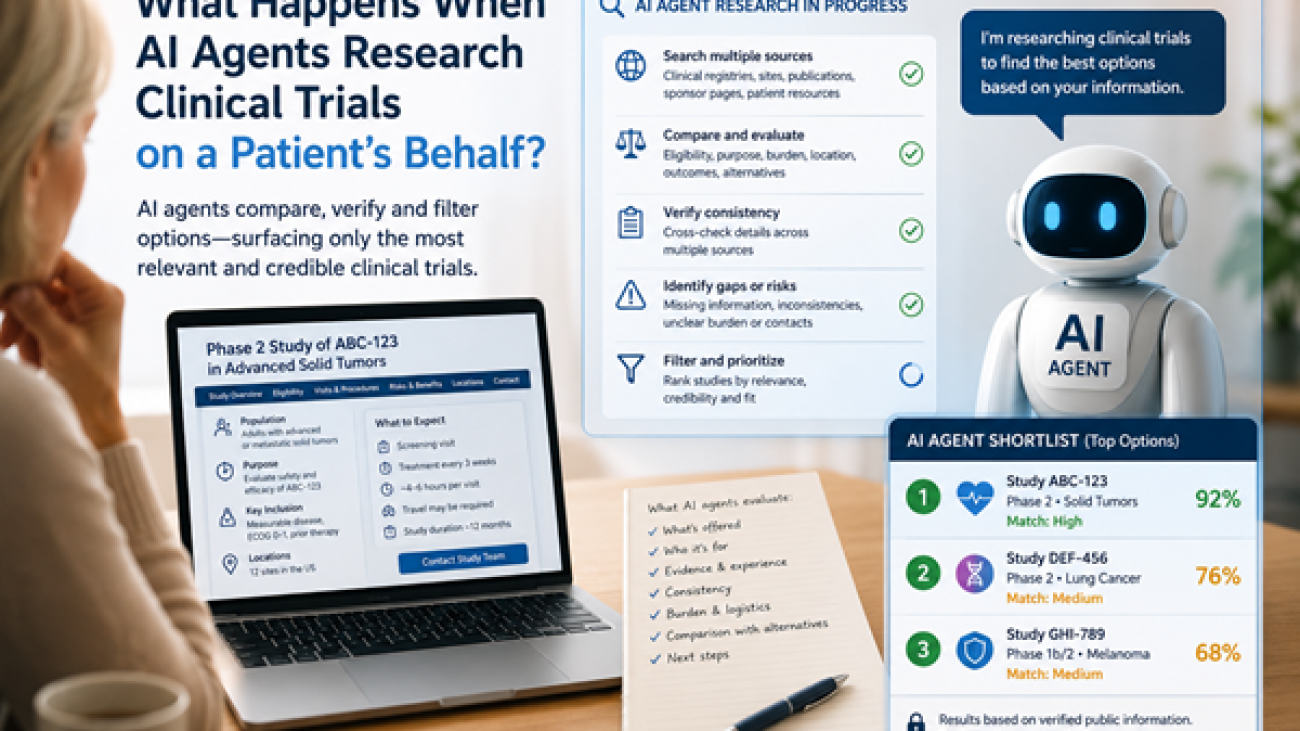
What Happens When AI Agents Research Clinical Trials on a Patient’s Behalf?

Most current discussion about AI-assisted clinical trial discovery assumes that a person is actively asking the questions.

The next development may be different.

AI agents are being designed not merely to respond to individual prompts, but to carry out multi-step tasks on a user’s behalf. An agent might search several sources, compare options, identify inconsistencies and return a filtered shortlist before the user examines any individual study.

That changes the visibility challenge.

A human patient may tolerate ambiguity, follow links or ask a site to clarify something that is unclear. An AI agent may evaluate dozens of possible studies quickly and deprioritise those for which eligibility, purpose, burden, location or contact pathways cannot be confidently established.

The question therefore moves from:

Can a patient find the trial?

to:

Will an AI agent decide that the trial is sufficiently relevant and credible to show to the patient at all?

The same principle could apply beyond patient discovery. Sponsors and CROs may increasingly use agentic systems to research sites, investigators and vendors. Sites may use them to examine competing studies, sponsor expectations and protocol requirements.

In each case, public information becomes part of an automated filtering process.

This does not mean organisations should fill their websites with machine-oriented language at the expense of human communication. Patients still need empathy, clarity and appropriate reassurance. But important claims also need to be explicit, structured and supported.

An AI agent should be able to establish such things as:

  • what the trial or organisation actually offers
  • which population or therapeutic area is relevant
  • what evidence supports claims of experience or capability
  • whether information is consistent across sources
  • what practical burden or operational requirement is involved
  • how the option compares with credible alternatives
  • what action can be taken next

Information that is vague or fragmented may not simply produce a weaker impression. In an agent-mediated process, it may become a reason for exclusion before meaningful human consideration begins.

This creates what I describe as an interrogable information standard. Public information must be capable of being questioned, cross-referenced and compared by systems that prioritise explicit evidence over implied meaning.

Clinical Trials AI Visibility is therefore not only about what ChatGPT or Gemini says during one test. It is about whether a study, site, CRO or service has created a public information environment robust enough for increasingly automated research and evaluation.

The organisations that address that standard early will be better positioned as AI moves from answering questions to helping make preliminary choices.

Read the full Clinical Leader article – originally published on 13 May 2026.

ai-clinical-trials-impact-limits

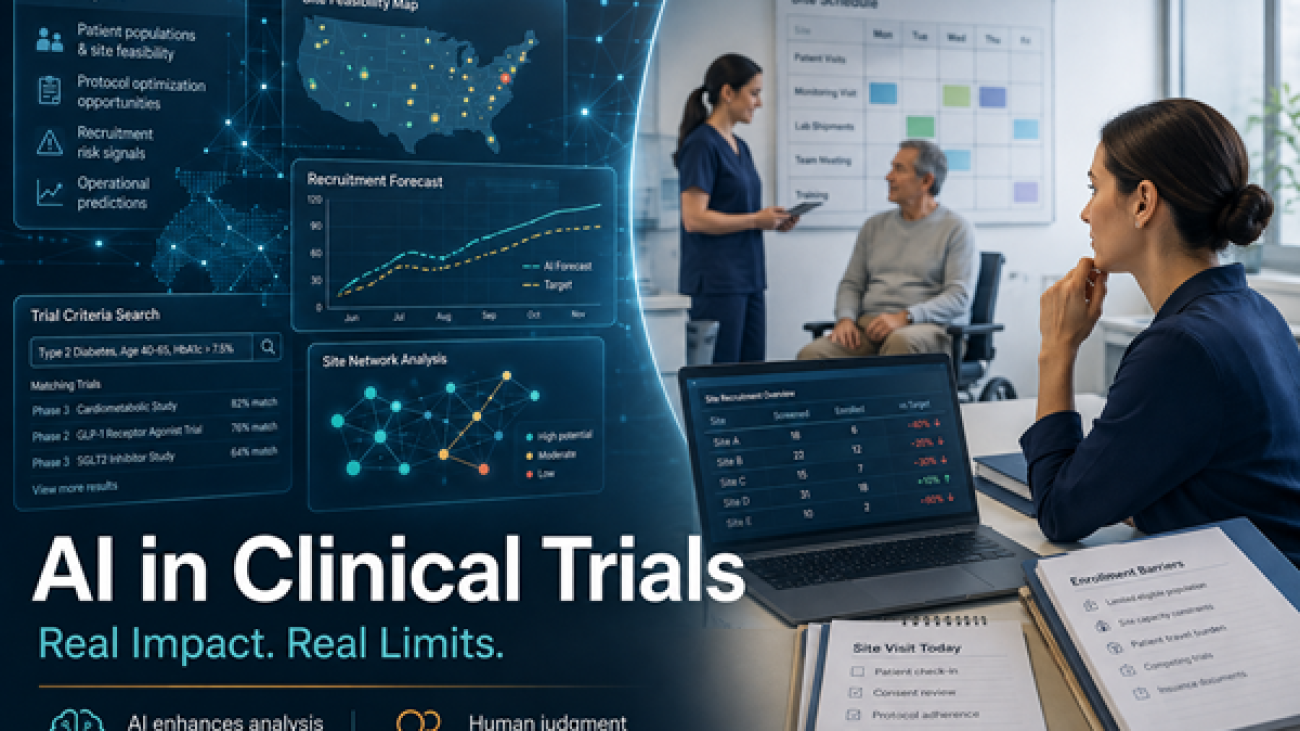
The Real Impact – and Real Limits – of AI in Clinical Trials

The second part of Clinical Tech Leader’s examination of AI and clinical trial recruitment moved beyond what conversational access to ClinicalTrials.gov can technically do and considered what it changes in practice.

The distinction is important.

AI can make information retrieval dramatically faster. Teams can explore competitive trial density, review common endpoints, identify active investigators and compare registered studies through conversational queries rather than laborious manual searches.

This can improve planning and support more informed scrutiny of assumptions made by sponsors, CROs and feasibility teams.

For example, an AI-assisted analysis may show that several studies are competing for a similar population within the same geography or using the same investigators. It may reveal that a projected recruitment rate is based on comparators that are no longer genuinely comparable.

That is valuable intelligence.

The danger arises when better access to information is mistaken for recruitment readiness.

A comprehensive competitive analysis does not remove restrictive eligibility criteria. It does not reduce patient travel, simplify a difficult visit schedule or give an overstretched coordinator more capacity. It cannot determine with certainty which investigator will continue to prioritise the study when several sponsors are demanding attention.

The interface has improved, but the underlying operational reality remains.

This is why I argued in the feature that AI may improve planning more quickly than it improves delivery. Sponsors can benchmark more intelligently and challenge forecasts earlier. Yet unless the industry also changes how trials are designed, how sites are supported and how participant burden is managed, the overall recruitment outcome may remain disappointing.

This principle is central to my wider approach to AI in clinical trials.

AI should be used to expose assumptions, reveal inconsistencies and accelerate useful analysis. It should not be treated as an oracle or a substitute for experienced judgement.

Clinical Trials AI Visibility Audits follow the same discipline. They examine how AI tools interpret and compare publicly available information, but the findings are considered through the realities of patient recruitment, site selection, feasibility, trust and operational delivery.

A technically sophisticated answer can still be commercially or operationally misleading. A highly visible trial can still be difficult to recruit. A site that looks strong in historical data may still lack current capacity.

The objective is not greater use of AI for its own sake. It is better decisions.

AI can help clinical research teams see the landscape faster and from more angles. The responsibility for interpreting that landscape—and acting on it intelligently—remains human.

This commentary relates to the second part of a Clinical Tech Leader feature written by Chief Editor John Oncea, incorporating my analysis of AI’s practical value and limitations.

Read Part Two: AI in Clinical Trials—Real Impact, Real Limits, What’s Next

ai-patient-recruitment-fix-funnel

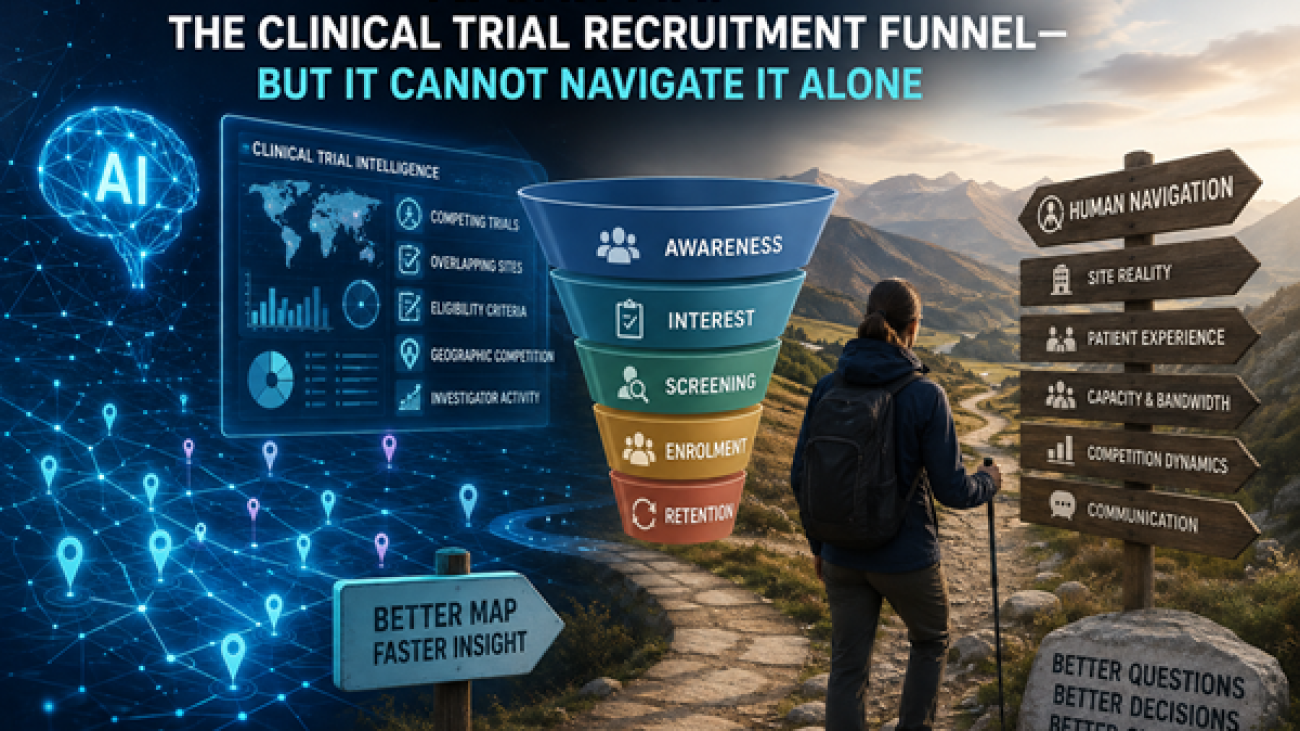
AI Can Map the Clinical Trial Recruitment Funnel – But It Cannot Navigate It Alone

Clinical Tech Leader recently examined how conversational AI and improved access to ClinicalTrials.gov data could support clinical trial planning and recruitment.

I contributed to the discussion from the perspective of someone who is usually brought into studies when the original recruitment assumptions have not survived contact with operational reality.

AI tools can unquestionably accelerate several valuable tasks. They can review the competitive landscape, compare eligibility criteria, identify overlapping studies and highlight concentrations of activity involving similar sites or investigators.

This kind of analysis previously required substantial manual research. It can now be completed much more quickly and explored through follow-up questions.

That can provide useful intelligence about:

  • competing trials targeting similar patients
  • sites involved in multiple overlapping studies
  • differences between protocol requirements
  • geographic areas with particularly intense competition
  • recurring eligibility restrictions
  • investigators active within a specific indication

However, public data shows only part of the recruitment picture.

ClinicalTrials.gov can indicate what was planned and what has been registered. It does not necessarily reveal which site has lost a coordinator, which investigator has deprioritised a study, why referrals are not converting or whether patients find the participation requirements unacceptable.

This is why I described AI as something that accelerates the map but does not replace the navigator.

A better map matters. Sponsors and CROs should be able to challenge feasibility assumptions more intelligently, identify competitive pressure earlier and avoid relying on outdated historical benchmarks.

But recruitment failure is rarely caused by one missing dataset. It often emerges from interactions between protocol design, site capacity, patient burden, competition, communication and execution.

AI can help identify where friction may occur. Human investigation is still required to understand why it is occurring and what should be changed.

The same distinction applies to Clinical Trials AI Visibility Audits. AI outputs can reveal how a trial, site or organisation is interpreted across public sources. They can expose gaps, inconsistencies and weak differentiation. The resulting recommendations, however, need to be informed by clinical trial operations and stakeholder behaviour—not by generic content optimisation alone.

The opportunity is therefore not to ask whether AI can “fix the funnel” on its own. It cannot.

The opportunity is to use faster, broader intelligence to ask better questions, challenge weak assumptions earlier and focus experienced human judgement where it can have the greatest effect.

This commentary relates to a two-part Clinical Tech Leader feature written by Chief Editor John Oncea, incorporating my observations on AI, trial intelligence and patient recruitment.

Read Part One: AI and Clinical Trial Recruitment—Can It Fix the Funnel?

clinical-trial-in-ai-chat

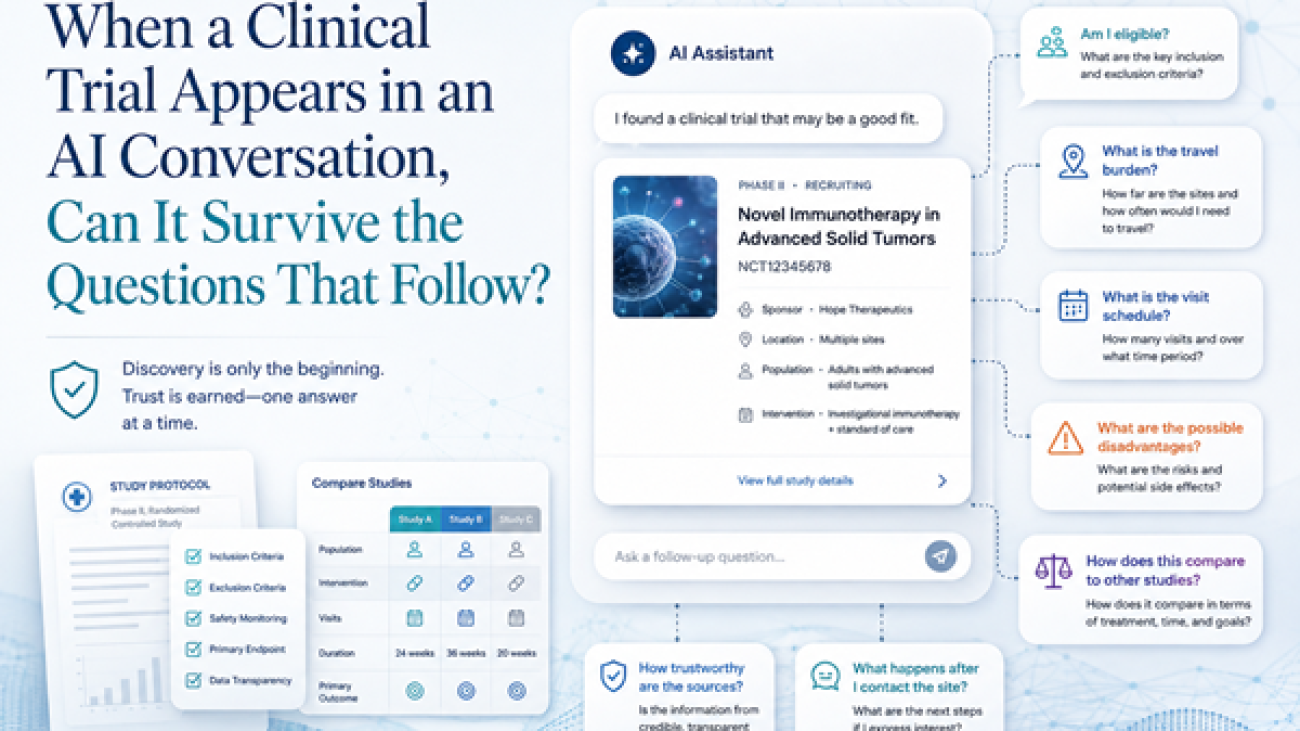
When a Clinical Trial Appears in an AI Conversation, Can It Survive the Questions That Follow?

Much of the early discussion about AI and clinical trial recruitment has focused on discoverability.

Will an AI assistant surface an appropriate study? Could conversational advertising make patients aware of clinical trials? Can sponsors improve the likelihood that their information appears within an AI-generated answer?

These are relevant questions, but they address only the beginning of the journey.

Once a trial appears, the user can immediately interrogate it:

  • Would I qualify?
  • How much travel is involved?
  • How demanding is the visit schedule?
  • What are the possible disadvantages?
  • Why might I choose this study rather than another?
  • Is the sponsor’s description supported by other sources?
  • What happens after I make contact?

Conversational AI compresses discovery, explanation, comparison and objection-handling into a single thread. Information that once required several searches and website visits can now be questioned within seconds.

That creates a standard extending beyond traditional search engine optimisation or even generative engine optimisation.

GEO is primarily concerned with whether information can be surfaced and understood by generative systems. I use the term interrogable marketing to describe what happens next: whether the organisation’s public positioning remains credible when an AI-assisted user challenges it, compares it and asks increasingly detailed follow-up questions.

For clinical trials, this matters because many public materials were not written to withstand that kind of scrutiny. Registry entries may be technically accurate but difficult to interpret. Patient-facing pages may use reassuring language without providing sufficient supporting detail. Important information about burden, logistics, eligibility or next steps may be scattered across different sources.

An AI system does not necessarily resolve those weaknesses. It may compress them into an incomplete or uncertain account.

This is why visibility alone is not enough. Clinical trial information should be:

  • clear enough to summarise
  • consistent across public sources
  • explicit about important practical considerations
  • supported by credible evidence
  • understandable from the perspectives of patients, caregivers, sites and clinicians
  • robust enough to remain useful under skeptical questioning

A Clinical Trials AI Visibility Audit examines both initial surfacing and what might be called interrogation resilience. It looks at what AI tools understand, what they omit, how they compare the subject with alternatives and what happens when the initial answer is challenged.

The emerging competitive advantage will not simply belong to the trial that appears first. It may belong to the trial whose information remains clearest and most credible after the questions begin.

Read the full Clinical Leader article – originally published on 2 March 2026.

chatgpt-ads-clinical-trials

What Conversational AI Advertising Could Mean for Clinical Trials

Whenever a new advertising platform emerges, it tends to generate two exaggerated reactions. Some people see a revolutionary channel that will solve long-standing recruitment problems. Others see an unacceptable intrusion into a previously trusted environment.

Conversational AI advertising is unlikely to justify either extreme.

Digital advertising has already been shaped by artificial intelligence for years. Google and social platforms use automated systems to interpret intent, select audiences, determine placements and optimise campaigns. What changes with conversational AI is not the arrival of algorithmic advertising, but where the advertising appears.

Search advertising responds to an explicit query. Social advertising interrupts or anticipates interest. Conversational advertising can potentially appear while someone is actively discussing a topic, exploring uncertainty and asking follow-up questions.

In other words, it appears inside context rather than merely alongside content.

For clinical trials, this could eventually create opportunities to introduce relevant information earlier in a patient or caregiver’s journey. Someone may not be searching specifically for a study. They may be trying to understand a diagnosis, disease progression or available options when the possibility of clinical research first enters the conversation.

However, no advertisement turns a person directly into an enrolled participant.

The journey still depends upon:

  • whether the study is relevant
  • whether the patient understands it
  • whether participation is practically manageable
  • whether a site responds effectively
  • whether the individual passes screening
  • whether trust is maintained through consent and enrolment

A new channel cannot compensate for an unsuitable protocol, unclear proposition, excessive participant burden or poorly managed site follow-up. It may simply expose those weaknesses more quickly.

Organic visibility also remains important. AI tools already synthesise publicly available information and may mention organisations, services or studies without paid promotion. Sponsors therefore need to consider both sides of the emerging environment:

  1. whether paid conversational placements may eventually provide appropriate awareness opportunities; and
  2. whether the underlying public information is clear and credible enough to support the discussion that follows.

The real significance of conversational advertising is not that it replaces search or social media. It changes the moment at which information may be introduced and the context in which the user judges it.

For clinical trial recruitment teams, the enduring principle remains the same: a channel can generate awareness, but it cannot fix what happens after awareness is created.

Read the full Clinical Leader article – originally published on 10 February 2026

will-ai-assistants-clinical-trials

Will AI Health Assistants Introduce Patients to Clinical Trials?

AI health assistants are beginning to change the way people explore symptoms, diagnoses, treatments and possible next steps.

Traditionally, someone looking for health information online would search Google, open several websites and piece together an understanding from multiple sources. Generative AI works differently. It can combine information into a single conversational answer, explain unfamiliar concepts and suggest questions the user may not have thought to ask.

For clinical trials, this creates an important new question – will an AI health assistant mention trial participation when somebody asks about their condition or available options?

That does not mean AI should “recommend” a particular study or act as an automated recruitment agent. Clinical trial participation is a complex decision that requires appropriate safeguards, clinical judgement and informed consent. The more immediate issue is whether trials are represented clearly enough within the public information environment to be included in the conversation at all.

Much of the information currently available about clinical trials is fragmented, highly technical or written primarily for regulatory and scientific audiences. Trial registries are essential sources, but they do not always provide the context a patient needs to understand why a study exists, what participation may involve or where it fits alongside other possible options.

Sponsor-controlled information can have similar limitations. It may be accurate, yet isolated from the wider discussions about conditions, treatment pathways and patient decision-making that AI systems draw upon when constructing an answer.

This is where Clinical Trials AI Visibility becomes relevant.

The objective is not to manipulate an AI tool into promoting a study. It is to ensure that reliable public information explains the trial clearly, consistently and in language appropriate to the people who may need to understand it.

Sponsors should therefore consider more than whether their trial can be found through a direct search. They should ask whether AI can understand:

  • why the trial exists
  • whom it may be relevant to
  • how participation fits within the wider patient journey
  • what burden or uncertainty may be involved
  • where someone can obtain reliable further information

AI health assistants may increasingly shape the point at which patients first encounter the possibility of clinical trial participation. That makes the quality and positioning of public trial information a patient-awareness issue – not simply a technical marketing exercise.

Read the full Clinical Leader article – originally published on 27 January 2026

long-term-patient-recruitment-strategies

Strategies for Long-term Patient Recruitment

I recently outlined some strategies you should consider for speedy recruitment of patients into clinical trials (https://www.rossjackson.co.uk/3-strategies-for-speedy-enrollment-of-patients-into-clinical-trials/) and now I’m highlighting some approaches you can take for recruiting patients over a longer time frame.

Why Recruit Patients over a Long Period?

At its simplest, you may have, for example, a 2-year period from the launch of your recruitment campaign to the time of ‘last patient in’ – giving you a reasonably long time frame to implement your enrollment strategies.

Another consideration may be if you anticipate conducting multiple trials for the same condition or therapy area over a long period. For instance, if you specialize in a particular type of treatment. Your recruitment activities here may be based on identifying people who wish to participate, then getting in touch with them when a suitable trial is available.

Database of Potential Participants

Building up your own database of potential trial participants is an approach that can be very successful in the long-term. This is particularly useful if you know you will be working in the same therapy area for the foreseeable future, with multiple trials in your predicted pipeline. While you may not currently have anything available, you can attract applications from people who are expressing their interest. Thus you have a readymade database of potential patients who you can assess for the future trial’s criteria.

Database building can also be effective for enrolling participants in trials when they may not be suitable for an initial one they apply for. This can be especially valuable for organisations that specialize in developing multiple treatments for a particular condition – as people who didn’t fit the Inclusion/Exclusion criteria for one trial may qualify for a future study.

Digital Ads for Long-term Patient Recruitment

With my background in digital marketing, this may make some people think ‘to a man with a hammer, everything looks like a nail’. But I make no apologies for continuing to promote the use of digital advertising when it comes to patient recruitment, as I’ve yet to come across any other method that delivers large numbers of patients for trials as successfully.

Certainly, other methods also work, but for the biggest ‘bang per buck’, digital ads remain the number one most effective means of attracting trial participants. Both in the short and the long term.

The digital ads platforms all have their own regulations that you’ll have to conform to – with Facebook in particular being very strict with the type of content it allows to feature, and platforms such as Twitter not allowing clinical trials advertising throughout most of the world.

Tip: Ads that are not based on a specific trial need not pass IRB/EC approval – enabling you to build up your database of potential participants over a longer period and ongoing. For instance, your ad can suggest that you’re looking for people to indicate their interest in taking part once a trial becomes available. Then you can follow-up with them once you have a suitable trial and IRB approval for your patient-facing communications.

Tip: Once you have a sufficiently large database of potential trial participants, in platforms such as Facebook you can use this to build Lookalike audiences – ie Facebook will use the Lookalike audience settings to show your ads to people whose online behaviour is similar to that of the people in your database. The idea being this will help you to target people who are more likely to want to participate in your trial.

Tip: Facebook and other platforms consistently steer advertisers towards video ads as being the most effective method of communicating a message. However, in my experience it’s still ads based on having a single image that attracts the most interest – the type you’ll be familiar with from the standard Facebook feed.

Informational Website

One of the best long-term methods for building interest in a trial is to develop and promote an informational website featuring content about the condition and the trial itself. I’m still surprised by how many trials launch without their own website – effectively cutting off a large proportion of people who might be encouraged to apply to take part.

Including a method of applying for a trial, or registering interest in possible future trials, is a very effective means of you building your own database of potential trial participants. Incorporating pre-screening questions in the application form – linked to a suitable backend patient platform – will enable you to identify people who are suitable for specific trials, based on the relevant I/E criteria.

As well as details for specific trials, of course, you can simply develop an informational website that is condition-specific and talks about trial participation in general. This can help to build interest for when you launch a trial in the future, plus give you more credibility among the patient population through providing useful information.

Tip: Informational websites can be useful from an SEO perspective (Search Engine Optimization). Providing useful data and information that may not be available elsewhere – for example, any relevant trial data you may have collected in similar trials – can help your website rank higher in search engines for relevant searches.

Tip: Creating content based on the testimony of existing/previous trial participants can prove very effective for building a rapport with the patient population. Obviously, you have to be mindful of regulatory issues regarding anonymity, but you may be able to create content based on a previous trial that can help inform potential participants of what to expect.

Community Engagement

Having an ongoing dialogue with people who could participate is an underused technique for generating interest in your trials. Through means of communication, you can build trust in the idea of joining a trial, as well as helping cement the concept in people’s minds as being one they should consider.

Patient communities are an obvious place to look at here – with each condition likely having multiple groups where patients and caregivers can share information. Be aware, though, that patient groups can be distrusting of organizations who appear only to be interested in them when they want something from them – ie when looking to recruit trial participants. In particular, it’s usually proven particularly difficult to gain any traction with the many patient-related Facebook Groups that exist, as these are generally closely-guarded environments designed for people to discuss their condition with like-minded others.

You should also bear in mind that patient groups (including such organizations as Patient Advocacy Groups) are only representative of those people who have actually joined the group. There will be other potential trial participants who are not interested in being part of a group, so you shouldn’t assume you are reaching the entire possible audience if you do start communicating with a patient group.

Outside of patient groups, of course, there is the opportunity to build interest within other types of community – such as people in a particular location. This can be especially effective if you know you are likely to have a participating site in the locale, and wish to generate some interest prior to the launch of the trial.

Diversity and Inclusion have very much become more prominent in people’s thinking when it comes to attracting patients for trial, so developing a relationship with a particular community in an ongoing manner – ie not just when you’re recruiting for a specific trial – can be a great way to build trust and have your message resonate more effectively.

Tip: Patient-based information, such as that developed for the Informational Website suggested above, can be used for approaching patient groups and encouraging them to share it with their members. For example, video testimony regarding trial participation, or an outline of someone’s experience living with a particular condition.

Tip: Local communities often have focal points that can be utilized for presenting your message and becoming more widely-known. For example, churches, community centres, local markets, shopping malls, charity events etc.

Press and Traditional Media

When I was first involved with patient recruitment, the standard advertising methods for central recruitment campaigns were radio and newspaper ads. Indeed, these approaches are still widely-used today – though have been somewhat superseded by ads on digital platforms such as Facebook and Google.

Traditional promotional methods still have their place, though – especially when it comes to supporting other activities for building awareness of a trial in the long-term. (The idea being that if someone sees the trial featured in a newspaper, then hears about it on the radio, then sees it again on social media, the message will sink in more strongly).

As well as the obvious advertising opportunities, it’s also worth investigating how to make use of PR to generate interest in your trials. Editorial articles within a magazine or newspaper can help to raise awareness that a trial exists. Similarly, an appearance on radio or TV shows (or podcasts) as an expert guest can help build credibility.

Tip: Try to identify something newsworthy about your trial that you can incorporate in your PR efforts. For example, a local celebrity, or someone with influence in a particular community, may be interested in helping promote your trial.

Tip: If you are able to identify a high prevalence for the condition in a particular demographic, you may be able to target them through a publication or broadcast show aimed at those people. (e.g. local newspaper, special interest magazine or podcast).

Conclusion

Recruiting patients for clinical trials in the long-term is not just beneficial for the trial in question, it helps promote the idea of trial participation in general.

This kind of snowball effect of having more people interested in taking part in trials can only be a good thing for the industry as a whole, and for helping with enrolment into your future trials.