

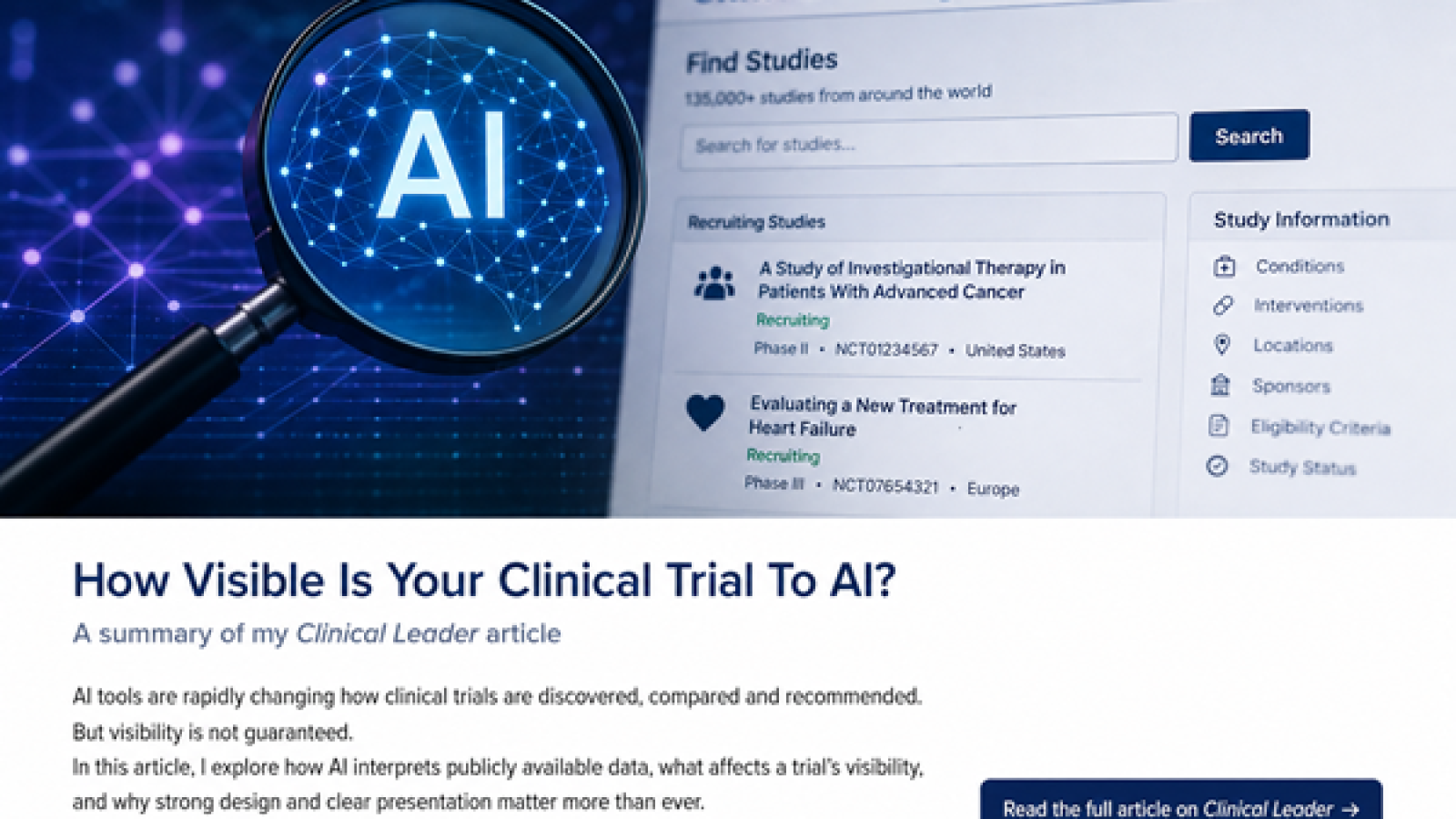
For years, clinical trial visibility has largely meant making sure a study could be found.
Is it listed on ClinicalTrials.gov? Is there a recruitment website? Can patients find it through search? Are physicians and research sites aware that it exists?
Those questions still matter. But the growing use of generative AI introduces another layer.
Patients, clinicians, investigators, research sites and even sponsors and CROs can now ask tools such as ChatGPT, Gemini, Claude, Copilot or Perplexity to research and explain clinical trials on their behalf.
And AI does not simply provide a list of links.
It interprets the information it finds.
That creates an important distinction between a trial being findable and being AI-ready.
Being mentioned by AI is only the beginning
An AI system may successfully identify a clinical trial while still providing an answer that does little to move the user forward.
For example, it might explain the science accurately but fail to make clear:
- which patients the study may be relevant to
- what participation is likely to involve
- where the trial is taking place
- how it differs from competing studies
- what a physician should do if they have a potentially suitable patient
- how a patient or caregiver can take the next step.
That trial is technically visible.
But from a patient recruitment or referral perspective, that visibility may have very little practical value.
This is why I increasingly distinguish between mentions, citations and actionability when considering AI visibility.
Being mentioned means the AI knows the study exists.
Being cited suggests that the system has found information it considers sufficiently useful or authoritative to support its answer.
But actionability asks the more commercially and operationally important question:
Does the resulting answer actually help the person make their next decision?
Different stakeholders ask different questions
There is another reason simply checking whether ChatGPT can identify a trial is insufficient.
Different people interrogate the same clinical trial very differently.
A patient may want to understand whether the study could be relevant to someone like them.
A physician may want to know which patients might qualify and how a referral would work.
A research site may want to understand protocol burden, recruitment feasibility and the sponsor’s operational expectations.
A sponsor or CRO evaluating a site or vendor will be looking for something different again.
An AI-generated answer can therefore be factually correct while still failing to provide the information that matters to the person asking the question.
This is why meaningful AI visibility testing needs to use realistic stakeholder scenarios rather than simply asking generic questions about a study or company.
The underlying information matters more than the AI
The objective should not be to manipulate ChatGPT or optimise content for whichever AI platform happens to be receiving the most attention this month.
AI systems are ultimately working from an information ecosystem that may include sponsor websites, trial registries, publications, press releases, patient advocacy organisations, hospital websites, investor presentations and third-party sources.
If those sources are incomplete, inconsistent or difficult to interpret, AI may reproduce those weaknesses.
The more sustainable approach is therefore to make clinical trial information:
- accurate
- current
- consistent
- understandable
- appropriately detailed for different stakeholders
- supported by credible sources
- connected to an obvious next step.
Those improvements benefit human visitors as well as AI systems.
And as AI increasingly becomes an intermediary between clinical research organisations and the people researching them, that distinction is likely to become increasingly important.
I explore this in more detail in my Clinical Leader article:
How Visible Is Your Clinical Trial To AI? – originally published on 03 August 2026.
The fundamental question is no longer simply whether information about a clinical trial exists online.
It is whether, when AI interprets that information, the resulting answer helps the right stakeholder take the right next step.