

Much of the early discussion about AI and clinical trial recruitment has focused on discoverability.
Will an AI assistant surface an appropriate study? Could conversational advertising make patients aware of clinical trials? Can sponsors improve the likelihood that their information appears within an AI-generated answer?
These are relevant questions, but they address only the beginning of the journey.
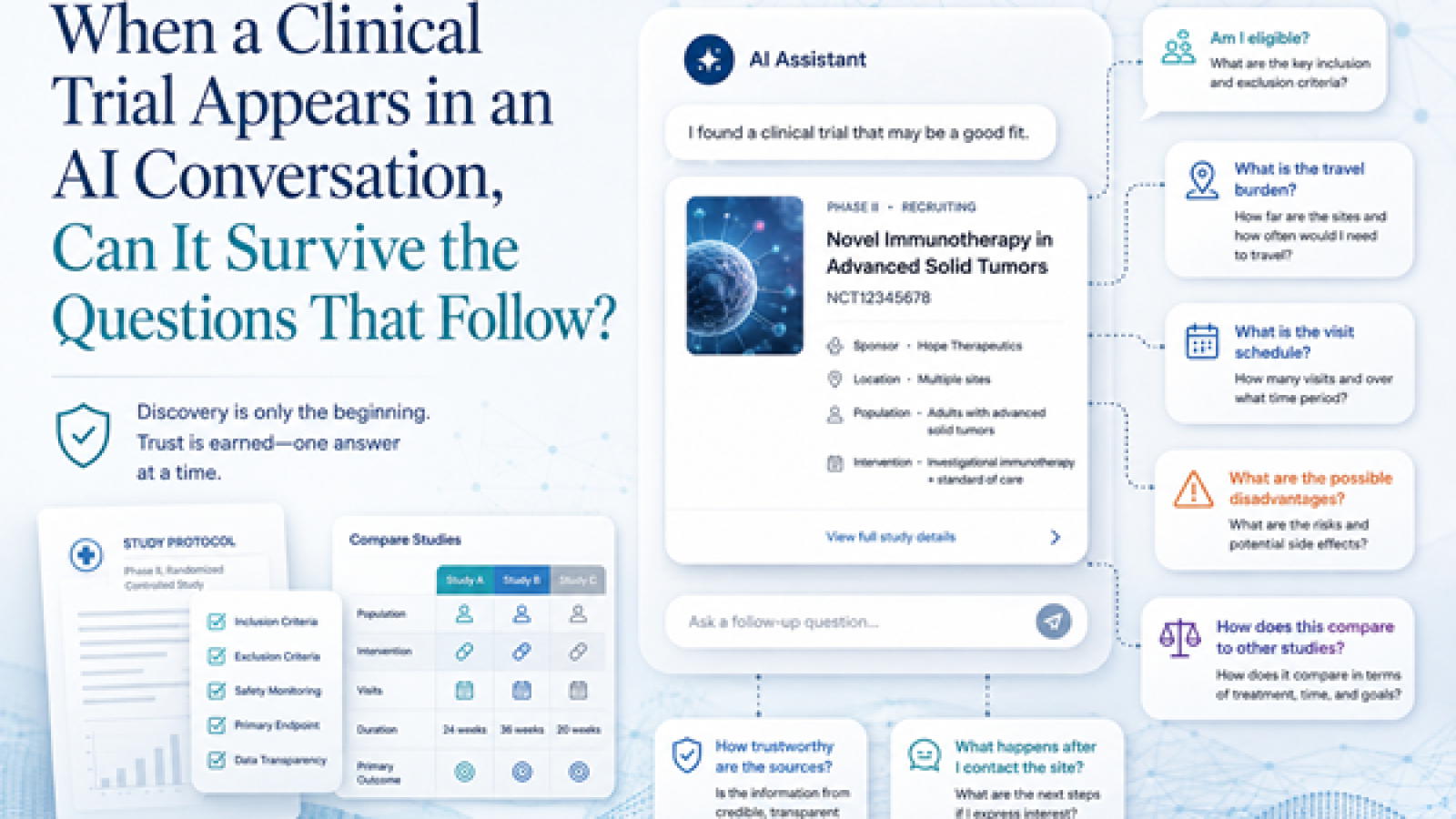
Once a trial appears, the user can immediately interrogate it:
- Would I qualify?
- How much travel is involved?
- How demanding is the visit schedule?
- What are the possible disadvantages?
- Why might I choose this study rather than another?
- Is the sponsor’s description supported by other sources?
- What happens after I make contact?
Conversational AI compresses discovery, explanation, comparison and objection-handling into a single thread. Information that once required several searches and website visits can now be questioned within seconds.
That creates a standard extending beyond traditional search engine optimisation or even generative engine optimisation.
GEO is primarily concerned with whether information can be surfaced and understood by generative systems. I use the term interrogable marketing to describe what happens next: whether the organisation’s public positioning remains credible when an AI-assisted user challenges it, compares it and asks increasingly detailed follow-up questions.
For clinical trials, this matters because many public materials were not written to withstand that kind of scrutiny. Registry entries may be technically accurate but difficult to interpret. Patient-facing pages may use reassuring language without providing sufficient supporting detail. Important information about burden, logistics, eligibility or next steps may be scattered across different sources.
An AI system does not necessarily resolve those weaknesses. It may compress them into an incomplete or uncertain account.
This is why visibility alone is not enough. Clinical trial information should be:
- clear enough to summarise
- consistent across public sources
- explicit about important practical considerations
- supported by credible evidence
- understandable from the perspectives of patients, caregivers, sites and clinicians
- robust enough to remain useful under skeptical questioning
A Clinical Trials AI Visibility Audit examines both initial surfacing and what might be called interrogation resilience. It looks at what AI tools understand, what they omit, how they compare the subject with alternatives and what happens when the initial answer is challenged.
The emerging competitive advantage will not simply belong to the trial that appears first. It may belong to the trial whose information remains clearest and most credible after the questions begin.
Read the full Clinical Leader article – originally published on 2 March 2026.