

Clinical Tech Leader recently examined how conversational AI and improved access to ClinicalTrials.gov data could support clinical trial planning and recruitment.
I contributed to the discussion from the perspective of someone who is usually brought into studies when the original recruitment assumptions have not survived contact with operational reality.
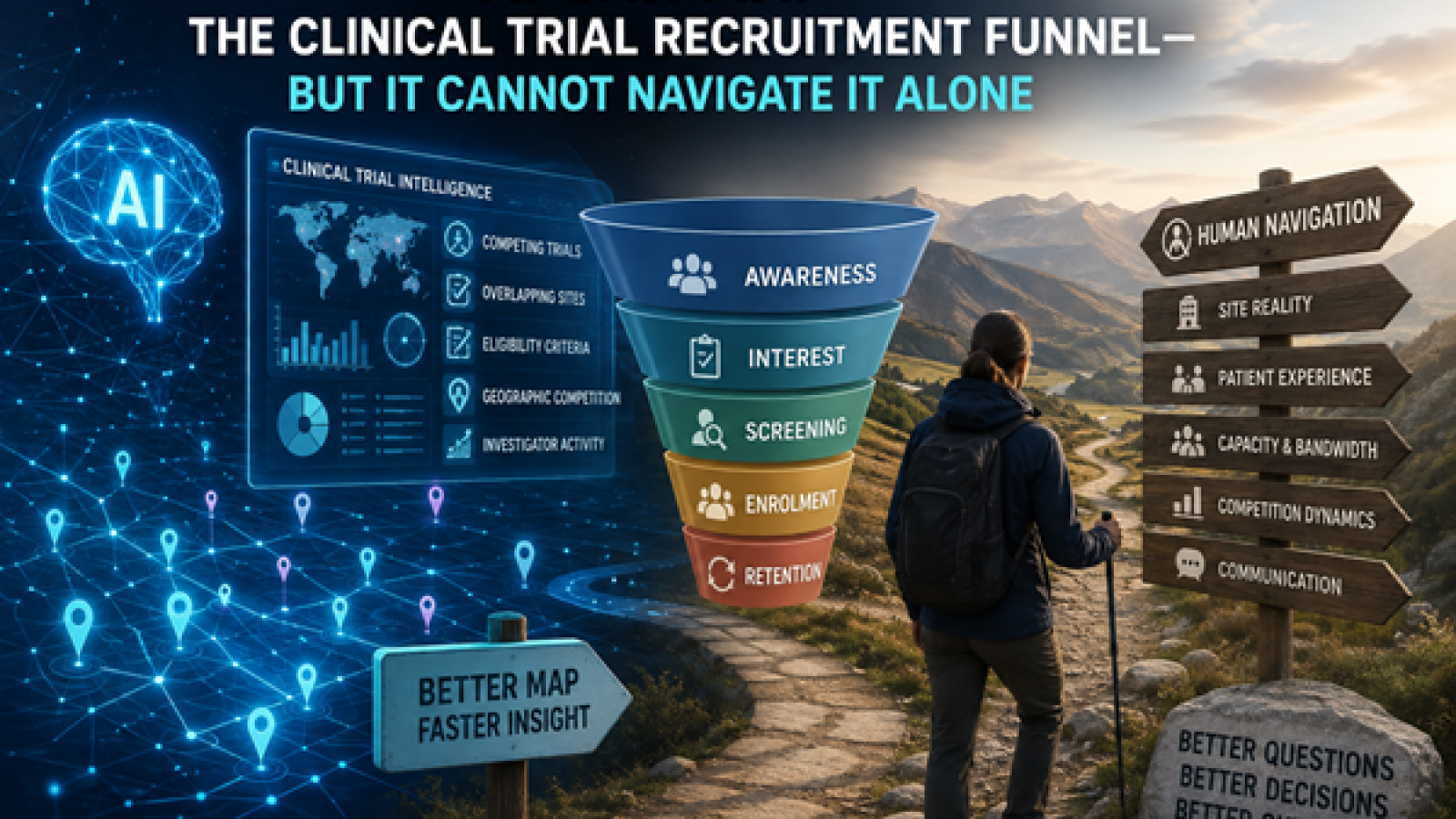
AI tools can unquestionably accelerate several valuable tasks. They can review the competitive landscape, compare eligibility criteria, identify overlapping studies and highlight concentrations of activity involving similar sites or investigators.
This kind of analysis previously required substantial manual research. It can now be completed much more quickly and explored through follow-up questions.
That can provide useful intelligence about:
- competing trials targeting similar patients
- sites involved in multiple overlapping studies
- differences between protocol requirements
- geographic areas with particularly intense competition
- recurring eligibility restrictions
- investigators active within a specific indication
However, public data shows only part of the recruitment picture.
ClinicalTrials.gov can indicate what was planned and what has been registered. It does not necessarily reveal which site has lost a coordinator, which investigator has deprioritised a study, why referrals are not converting or whether patients find the participation requirements unacceptable.
This is why I described AI as something that accelerates the map but does not replace the navigator.
A better map matters. Sponsors and CROs should be able to challenge feasibility assumptions more intelligently, identify competitive pressure earlier and avoid relying on outdated historical benchmarks.
But recruitment failure is rarely caused by one missing dataset. It often emerges from interactions between protocol design, site capacity, patient burden, competition, communication and execution.
AI can help identify where friction may occur. Human investigation is still required to understand why it is occurring and what should be changed.
The same distinction applies to Clinical Trials AI Visibility Audits. AI outputs can reveal how a trial, site or organisation is interpreted across public sources. They can expose gaps, inconsistencies and weak differentiation. The resulting recommendations, however, need to be informed by clinical trial operations and stakeholder behaviour—not by generic content optimisation alone.
The opportunity is therefore not to ask whether AI can “fix the funnel” on its own. It cannot.
The opportunity is to use faster, broader intelligence to ask better questions, challenge weak assumptions earlier and focus experienced human judgement where it can have the greatest effect.
This commentary relates to a two-part Clinical Tech Leader feature written by Chief Editor John Oncea, incorporating my observations on AI, trial intelligence and patient recruitment.
Read Part One: AI and Clinical Trial Recruitment—Can It Fix the Funnel?